Factory: Idle & Tycoon Game
- 4.4
- Rating
- 1.00M
- Installs
- Free
- Price

 Analysis by App-foxy
Factory: Idle made a good first impression on me because it understands the appeal of watching a small operation become more organized and productive. Rather than asking me to react quickly, it invited me to build a business at my own pace, check what was happening, and decide where the next improvement should go. That makes it an approachable strategy game for short sessions, although its relaxed presentation will not suit anyone looking for constant action or deep tactical conflict.
Brightika, Inc. presents the game as a capitalist simulator, and that description is useful as long as it is read in a light, game-like way. I am managing growth, arranging progress, and trying to make the operation more efficient. The pleasure comes from turning a modest setup into something that feels increasingly capable. The game is free to download, with optional purchases ranging from $0.99 to $99.99 per item, so the most important question is not whether it can be started without paying, but whether its pacing remains comfortable for a player who prefers not to spend.
From a simple factory idea to a playable routine
I found that the factory idea becomes most enjoyable when I treat each visit as a small management check rather than a tapping session. This section looks at how that routine develops, where the game’s light strategy comes from, and why a focused choice can make progress feel more meaningful. It also sets up the key question: whether this steady pace is a strength or a limitation for you.
You May Also Like

 Blood Strike: 2.5 Anniversary
Blood Strike’s Loadouts Turn Every Drop Into a Tactical Gamble
A close look at Blood Strike’s custom loadouts: how fast access to signature weapons reshapes its battle royale rhythm, rewards preparation, and narrows the gap between fights.

 Pandora - Music & Podcasts
Pandora’s Music Is Easy to Start, but Harder to Recover
Pandora’s strength is its low-effort path from a seed to a station. Its weak spot is how much confidence it asks you to place in connection, setup, and quiet recovery.

 8 Ball Pool
 Is Built on Rivalries, Rematches, and Routine
A close look at the rivalries, rematches, shared routines, and unanswered safety questions that turn a quick pool match into a persistent mobile community.

 Samsung Music
’s Quiet Strength Is Playing What You Already Own
Its reach comes less from spectacle than from dependable access to a personal library. That simplicity is both the app’s strongest retention engine and its ceiling.

 AccuWeather: Weather Radar
AccuWeather Review: A Quick, Clear Forecast for Everyday Decisions
For everyday plans, the best forecast is the one you can understand quickly. AccuWeather makes rain timing, radar, and local conditions easy to act on, with a few trade-offs.

 Hill Climb Racing
Why Hill Climb Racing Still Turns Crashes Into One More Run
A tiny car, a bumpy hill and one more upgrade: Hill Climb Racing keeps resurfacing because its simple chaos makes every near-miss feel personal.
More From Our News Desk



The first minutes are about understanding the loop
My first useful takeaway was that this is a game built around routine rather than surprise. I look at the current state of the business, notice what is holding progress back, and make a decision that should improve the next cycle. That structure is easy to understand, which is one reason the game works well for people who enjoy management themes but do not want a complicated tutorial before they can begin.
The strategy is not about memorizing a large rulebook. It is about learning to read momentum. A choice that seems attractive because it produces an immediate benefit may not be the best use of resources if it leaves the wider operation poorly balanced. I found that the most satisfying decisions were the ones that improved the whole flow rather than simply making one part look stronger.
That also gives the game a clear audience. If you like incremental progress, business simulations, and the quiet satisfaction of improving a system, the central idea is easy to enjoy. If you need direct competition, dramatic reversals, or a strong narrative campaign, this may feel too gentle. The game’s identity comes from management and accumulation, not from a constantly changing battlefield.
Why the setting feels coherent
The factory setting gives every improvement a practical meaning. Growth is not presented as an abstract score climbing for no reason; it is connected to the image of a business becoming more capable. Even when the underlying activity is simple, the setting helps me understand what I am trying to achieve. I am not merely collecting points. I am shaping an operation and trying to make it work more smoothly.
That world language is important in an idle game. These games can easily become a row of buttons and counters, but the industrial theme gives the progress a recognizable personality. I can imagine the difference between a neglected operation and one that has been carefully developed. The result is a playable mood that is calm, practical, and slightly aspirational without pretending to be a serious economics lesson.
I would not choose this game for a detailed simulation of real manufacturing. Its business fantasy is simplified for accessibility, and that is part of the appeal. The game gives me the feeling of running a growing enterprise without demanding that I understand supply chains, accounting, or production engineering. Players who want realism should look elsewhere; players who want the atmosphere of management with a lighter learning curve will probably be more comfortable here.
Visual direction and the feeling of progress
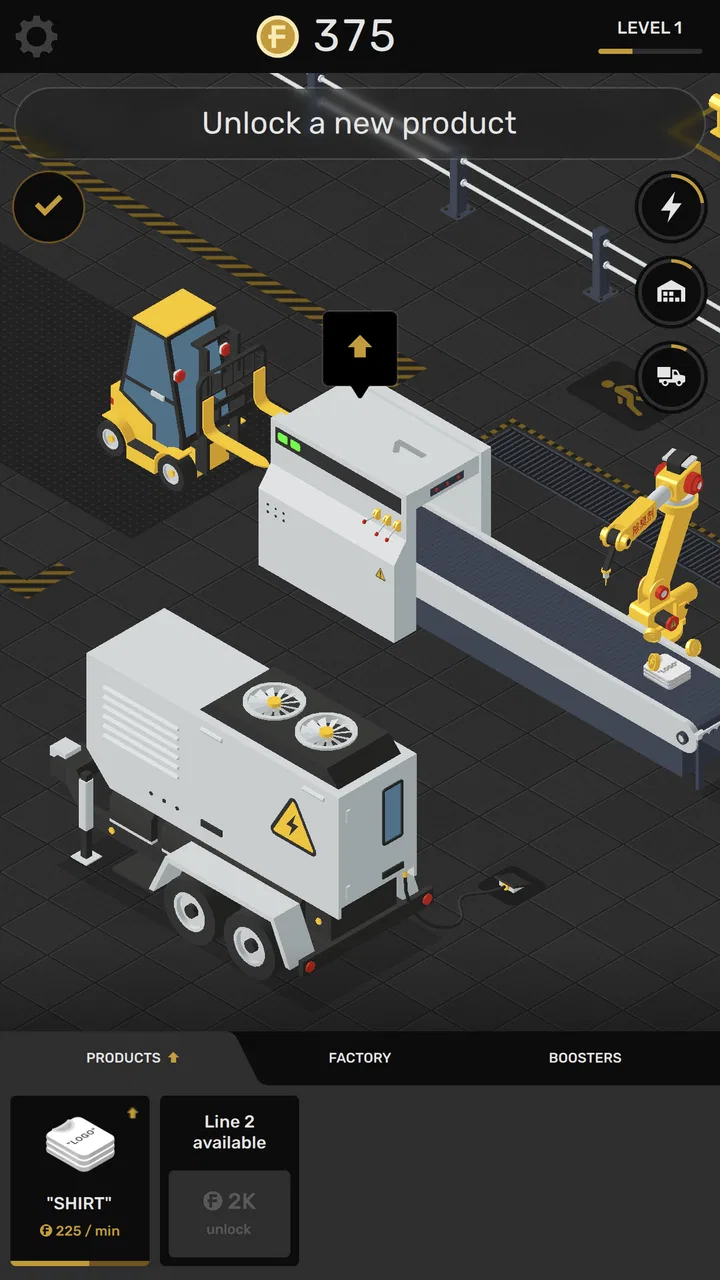
The visual idea works best when it supports readability. In a management game, I need to understand what deserves attention before I make a decision. Factory: Idle keeps the focus on the operation itself and on the sense that each improvement contributes to a larger whole. That makes the setting feel functional rather than decorative.
I also like that the industrial theme gives the game a consistent emotional tone. The factory is a place of repetition, organization, and gradual expansion, so the slower pace feels appropriate rather than accidental. The art direction does not need to turn every upgrade into a spectacle. Its job is to make the progress legible and to keep the business fantasy intact, and it generally does that.
One practical tip is to avoid judging the game by the first few minutes alone. The opening phase is mainly about learning the language of the operation. The more useful question is whether you enjoy checking a system, making a small adjustment, and returning later to see the result. If that loop already feels satisfying, the presentation has done its job. If it feels empty from the start, a more visually dramatic strategy game may be a better match.
Sound, silence, and the rhythm of checking in
The audio experience supports the game’s unhurried character rather than competing with it. I do not approach this as a game that needs a soundtrack to push me into constant activity. Its mood works better when I can concentrate on the business decisions and let the atmosphere remain in the background.
That restraint is a strength for a game designed around repeated visits. I can play while taking a short break, then put it down without feeling that I have interrupted a dramatic sequence. The rhythm is closer to checking a personal project than participating in an urgent contest. For me, that made the game easy to fit around other activities.
There is a trade-off, though. Players who expect memorable musical themes or strong sound effects to make every upgrade feel exciting may find the experience understated. The sound and pacing create a coherent mood, but they do not transform ordinary management actions into major events. This is a game I play for the satisfaction of progress, not for audio spectacle.
A realistic everyday use case
I can see Factory: Idle fitting naturally into a busy day. Imagine opening it during a lunch break, reviewing how the operation is developing, choosing one improvement, and closing the game before returning to work. Later, I can check whether that decision created a better rhythm or revealed a new bottleneck. The session does not need to become an evening-long commitment to feel worthwhile.
This is also where the idle structure can be useful. It gives the game a reason to remain part of a routine, but it creates a responsibility for the player: do not treat every return as a demand to spend. I prefer to decide in advance what I am trying to improve and then judge the result, rather than tapping through every available option without a plan. That approach makes the strategy clearer and reduces the temptation to confuse activity with progress.
Where the strategy actually lives
The strategic layer is found in priorities. I have to decide whether the operation needs broader growth, better balance, or a more immediate boost. That may sound simple, but it changes how I view each session. Instead of asking only, “What can I buy now?”, I ask, “What will make the next several steps easier?” That shift is one of the game’s more valuable lessons.
A useful workflow is to choose a single objective before spending anything. For example, I might focus on making the current production flow more reliable, then avoid unrelated upgrades until I can see whether that plan worked. This prevents scattered decisions and makes the results easier to understand. It is a small habit, but it turns casual tapping into genuine management.
Another trade-off is between immediate satisfaction and long-term efficiency. A quick improvement can make the game feel rewarding right away, while a less obvious choice may create a stronger foundation. I enjoyed this tension because it gives the simple interface a little more thought. The game does not need complex spreadsheets to make me consider consequences; it only needs choices that affect how smoothly the next stage develops.
How it compares with other strategy games
Compared with a traditional strategy game, this one asks for less constant attention and offers much less direct conflict. There is no need to monitor opponents in the same way I would in a competitive title, and the pressure comes from managing my own progress rather than defeating another player. That makes it more relaxing, but also less dramatic.
Compared with a pure idle clicker, the factory theme gives my decisions more context. I am not only watching a number rise. I am thinking about a business, its direction, and the order in which improvements make sense. The difference is subtle, but it helps the game feel more purposeful than a loop based entirely on repeated tapping.
Compared with a detailed tycoon simulation, Factory: Idle is easier to enter and less demanding to maintain. That accessibility is welcome on a phone, especially when I want a short session. The cost is depth: players who want complex logistics, employee management, market shocks, or a highly realistic economic model may find the simplified approach too limited. I would choose this game for a calm management fantasy, not for a full business simulation.
Progression without losing the mood
The pacing is the feature that determines whether the game stays enjoyable. A well-paced idle strategy game gives me enough progress to feel that my choices matter, while still leaving room for the next decision. Factory: Idle generally aims for that middle ground. It encourages patience, but it also gives the player reasons to return and reassess the operation.
My advice is to treat slower periods as part of the design rather than as a problem to solve immediately with a purchase. When progress feels less exciting, I would first reconsider the current priority and check whether I have been spreading resources too widely. Sometimes the issue is not that the game has stopped being rewarding, but that my plan has become unfocused.
The free-to-play structure remains a consideration. Optional purchases can be convenient for people who want to accelerate their experience, but they can also weaken the sense of achievement if used whenever progress becomes slow. I think the game is best approached with a personal spending limit decided before playing. That keeps the business decisions in the game from being replaced by payment decisions outside it.
Who should play it, and who should skip it
I would recommend it to someone who enjoys management games but wants a forgiving pace. It is especially suitable for players who like checking progress several times during the day, making small adjustments, and watching a themed system become more capable. The factory setting also makes it easier to stay emotionally connected to the goal than in an abstract number-based idle game.
I would be more cautious recommending it to someone who needs a strong story, constant novelty, or intense tactical pressure. The game’s appeal depends on finding pleasure in repetition and gradual improvement. If the idea of returning to review a business feels like maintenance rather than play, the relaxed rhythm will probably become a limitation instead of a strength.
It is also not my first choice for players who want a serious economic simulator. The capitalist theme is a framework for accessible strategy, not a promise of real-world business accuracy. A deeper tycoon game would be better for someone who wants detailed production chains and difficult market decisions. Factory: Idle is more comfortable when the goal is to enjoy the shape of management without carrying all of its complexity.
Practical details before installing
The game is free and rated Everyone, which makes it an easy title to try for a broad audience. It was released on July 14, 2022, and the current version is 1.4.5. On the platform side, it requires Android 9 or later. Those details matter if you are using an older device or deciding whether the game is suitable for a shared family phone.
Its reach is already substantial, with over one million installs, while the average rating sits at 4.2 from around 7.2 thousand ratings. The listing also shows about 240 written reviews. I read those figures as a sign that the concept has found a real audience, but not as a guarantee that every player will enjoy the pacing. Ratings can confirm that a game is worth investigating; they cannot replace matching its rhythm to your own preferences.
The in-app purchase range deserves a deliberate look before playing. Items begin at $0.99 and can reach $99.99, so the difference between trying the game casually and spending heavily is significant. I would disable impulsive purchasing where appropriate, play long enough to understand the normal progression, and only then decide whether an optional purchase adds enjoyment rather than simply removing waiting.
The atmosphere verdict
After spending time with Factory: Idle, I see its strongest achievement in the way its setting, presentation, and mechanics point in the same direction. The factory theme supports the management decisions, the restrained rhythm supports repeated short sessions, and the gradual progression makes the operation feel like something I am shaping rather than merely observing.
It is not a game I would recommend for adrenaline or dramatic storytelling. Its rewards are quieter: a better plan, a smoother cycle, and the feeling that a small decision has improved the whole business. That can be surprisingly satisfying when I want something thoughtful but undemanding.
My honest recommendation is to try it if you enjoy calm, incremental strategy and can accept a simplified business model. Keep your priorities focused, resist treating every slowdown as a reason to pay, and give the factory time to establish its rhythm. If that kind of progress feels rewarding, this is an inviting mobile management game. If you need conflict, realism, or constant visual excitement, a different strategy title will serve you better.
Factory: Idle succeeds because it does not fight its own identity. It creates a modest industrial mood, gives the player understandable goals, and lets the satisfaction come from making an operation work better over time. For me, that coherence is more valuable than a louder presentation, and it is the main reason I would recommend giving the game a fair trial.
FAQs for Factory: Idle & Tycoon Game
01What is Factory: Idle & Tycoon Game about?
Factory: Idle & Tycoon Game is a strategic simulation game where players manage and expand their own factory empire. The goal is to optimize production lines, increase efficiency, and maximize profits. Players can unlock new machines, hire workers, and delve into resource management to become the ultimate industrial tycoon.
02Is Factory: Idle & Tycoon Game free to play?
Yes, Factory: Idle & Tycoon Game is free to download and play. However, it offers in-app purchases for players who wish to speed up their progress or acquire special items. These purchases aren't necessary to enjoy the game but can enhance the gameplay experience.
03What platforms is Factory: Idle & Tycoon Game available on?
Factory: Idle & Tycoon Game is available on both Android and iOS platforms. Users can download it from the Google Play Store for Android devices or the Apple App Store for iOS devices. Ensure your device meets the minimum system requirements for optimal performance.
04Does the game require an internet connection?
Factory: Idle & Tycoon Game can be played offline, allowing users to enjoy the game without an internet connection. However, certain features, such as leaderboards and cloud saves, require internet access. Connecting to the internet also ensures the latest updates and content are available.
05How does Factory: Idle & Tycoon Game handle ads?
The game includes ads that appear periodically, which can be removed through in-app purchases. Watching ads can also offer rewards like bonuses or extra resources. This setup allows players to choose between ad-supported play and a more streamlined experience through purchase options.
Pros
- Engaging gameplay with strategic depth.
- Intuitive controls for easy navigation.
- Regular updates with new content.
- Offline mode available for play anywhere.
- Visually appealing graphics and design.
Cons
- In-app purchases can be pricey.
- Progress can feel slow without boosts.
- Occasional ads interrupt gameplay.
- Limited customization options.
- Requires frequent internet connection.

Factory: Idle & Tycoon Game
Gallery